Jolly Cosmology: Reflections on a Psychedelic Journey
An essay
Reading time: 17 minutes
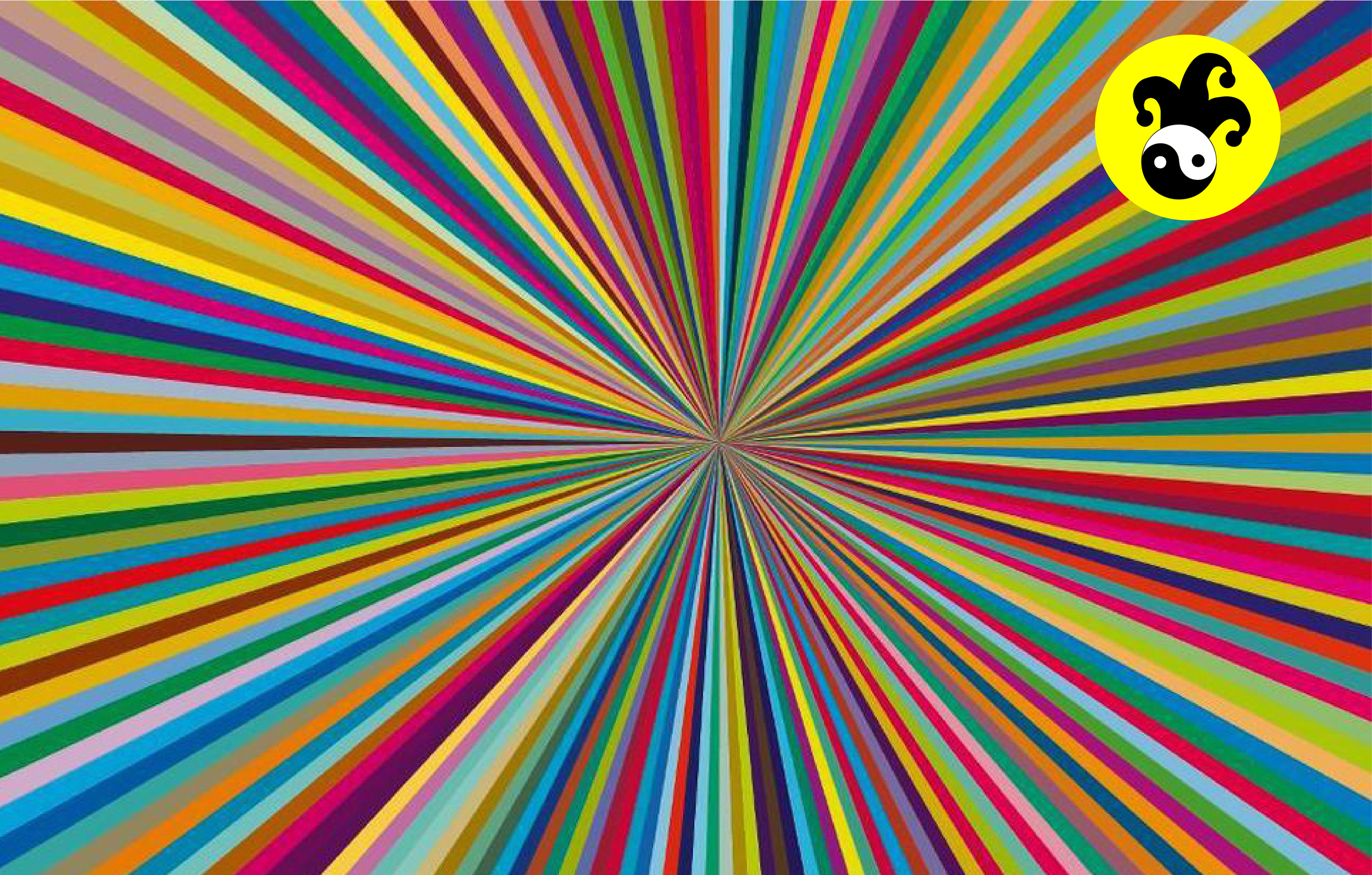
Book cover (part) of Penguin House edition of The Psychedelic Experience by Tomothy Leary, Ralph Metzner, and Richard Alpert (Ram Dass).
“Have you seen the light?”
“Oh yes!”
“And?”
“It sounded white, looked F-sharp, tasted circular, felt bitter, and smelled wiggly.”
The Wisdom of Nonsense
At first glance, such interchangeability of the senses sounds like nonsense. After all, we can’t smell forms, hear colours, or see sounds. Can we?
Why yes, we can! For this nonsense is exactly what the universe is: colourful and wiggly. An ever changing phantasmagoria with nowhere to stand and nothing to hold onto.
Which is why we call it ‘nonsense’ because our thinking mind, or ego, desperately needs footholds. If it can’t be logically explained, it cannot exist. And as soon as we have defined some thing or someone, it/he/she cannot change into something else. That would deviate completely from our image of how the world ought to be. Which is why events such as sickness, old age, divorce, and death, for instance, have become so disruptive.
Thus the harder we cling to our image of the world, the more we suffer when the world doesn’t adhere to it. And the harder we cling to a particular image of our self, the more we suffer if our thoughts, words, or actions, deviate from it.
Multiple Realms of Reality
As children we’re being culturalized. Our parents, teachers, and peers, tell us who we are by imposing both their own and their society’s norms and values unto us. Most of us buy this story on face value and rigidly stick to it until death. We teach ourselves that our image of our self and the world is the absolute truth. In so doing, we are shutting ourselves off from accessing those parts of our brain which “contain file cards for billions of images (sensory perceptions, red.) from the history of ourselves, of the race, and of living forms”.[1] Effectively we are shutting ourselves off from most of reality. We teach ourselves to only see what we wish to see, instead of what there is.
Psychedelics like psilocybin, mescaline, and LSD, for instance, can be considered as keys to unlock our doors of perception – as Aldous Huxley aptly titled the book about his own psychedelic journey: “It had always seemed to me possible that, through hypnosis, for example, or autohypnosis, by means of systematic meditation, or else by taking the appropriate drug, I might so change my ordinary mode of consciousness as to be able to know, from the inside, what the visionary, the medium, even the mystic were talking about.”[2]
I thoroughly relate to the urge to explore beyond our everyday consciousness. For I, too, for a long time, bought into the story of Erik and who he ought to be. One result thereof was that my ex-wife and I rigidly held on to our marriage even though we both intuitively knew that it had run its course. Those last years together were marked with heavy rows, standing opposite one another while accusing, blaming, and shouting back and forth. Yet, every time that happened, I vividly remember how much I did not want that to happen. So why did it? If I did not want yell and shout against someone who I still loved dearly, and it happened anyway, then who was the one doing the shouting?
At the same time I rapidly began to take an interest in psychology, religion, mythology, and social sciences; anything that dealt in one way or another with human thinking, feeling, and behaviour. During these years I became heavily influenced by Alan Watts. I shared his emphasis on the joy of discipline, or skill: “Without skill, life is a drag. Only when you’re skilled at something, then carrying out that activity can become an immense source of joy.”
Watts particularly aimed this teaching at the hippies who were ‘turning on, tuning in, and dropping out’[3] on psychedelics in the 1960’s. Most of them, according to Watts, went into these psychedelic journeys unprepared. Therefore, the invaluable lessons one can learn (particularly about oneself) by means of such a journey were lost. For many, the goal was to ‘get high’ and stay high for as long as possible. But, as Ram Dass later found out: “the game is not go get high (from which you necessarily always must come down), but the game is to become free.”
Thus the more I read Hindu, Buddhist, and Taoist scriptures, the more I became aware that as human beings, we simultaneously live on multiple planes of reality. And that our ignorance thereof creates heaps of suffering due to our inability to move with the tides of life.
Now, I’d had experiences with magic truffles before. However, that was long before my studies into anatomy, physiology, psychology, and myself. I was an unprepared hippie who was looking for ‘a good time’. Thankfully though, my studies and experiences in the past fourteen years provided a solid ground for turning my next psychedelic journey into a genuine exploration and initiation into consciously experiencing different realms of reality than the one we’re all too familiar with.
Preparation for the Journey
A thorough preparation, in combination with a trained guide and a safe place to travel, are paramount for an educational and insightful psychedelic journey. Moreover, when the student is ready, the teacher will appear.
It was thus about a month ago that I randomly met a lady at an ecstatic dance event, who turned out to be a guide in psychedelic journeys and who lives in a village next to mine. As had been the intention to undertake my next psychedelic journey under the supervision of a trained guide, soon a date was determined for a psilocybin experience.
In preparation I studied The Psychedelic Experience extensively.[1] This is a manual to guide an explorer through a psychedelic journey, based on a reinterpretation of the Bardo Thödol (Tibetan Book of the Dead) by way of chemical mind expansion. It provides an apt overview of various experiences one can encounter, based on the three bardos from the Bardo Thödol. These bardos represent the stages of a psychedelic journey, from the initial period of ego-loss (first bardo), via the period of hallucinations (second bardo), unto the period of re-entry (back into normal everyday consciousness; third bardo).
The beauty of this manual is that it is based on many experiments with psychedelics by the authors on themselves and others. Timothy Leary, Ralph Metzner and Richard Alpert (Ram Dass) identified not only the ecstatic states (the peaceful deities in the Bardo Thödol) but also the horrific states (the wrathful deities) one can encounter. They found out that, without exception, the horrific states happened as a result of resistance from the explorer (that is, his ego) towards whatever he or she was perceiving. The more controlling and judgemental ones personality, the less likely one is able to embrace perceptions which cannot be controlled. Therefore, the manual contains many symptoms to recognize if someone is having a ‘bad trip’, and means for the guide to help the psychedelic explorer back on track.
Yet, having said that, it is also recognized that even a bad trip can contain valuable lessons for the explorer. After all, every perception that happens during a psychedelic journey is a product of one’s own brain. Thus a bad trip can point to a certain level of rigidity, of an inability to let go, which most likely is reflected in certain life areas of the explorer. If I had engaged in a psychedelic journey during the years leading up to my divorce, there’s a good chance that would have ended in a ‘bad’ trip as well.
Experiences on the Journey
A linear description of the experiences during this journey proves quite impossible. That is because from the moment the truffle medicine begins to take effect, there is an almost immediate liberation from space-time limits. Therefore, I will list the most memorable experiences and insights in what might seem like a somewhat haphazard order. However, this is exactly the order of the universe, which is multi-directional. Everything is always happening at the same time – a concept that our linear intellect is usually unable to grasp.
Yet as soon as there was liberation from space-time limits in the journey, there was simultaneously liberation from the ego. For those areas of my brain containing the aforementioned file cards on all organic life, it felt like coming home.
The journey started in my usual meditation position: cross legged, eyes closed, and with my hands folded in my lap. I was determined to evenly welcome every perception the medicine would offer: good or bad, beautiful or ugly, beatific or horrific. Knowing that my brain, and nothing else, was the conjurer of it all, gave me a deep understanding that whatever would emerge, would be valuable and important for my personal development.
Very quickly awareness of my physical sensations seemed to increase by the moment. At the onset I experienced a little headache, which was attributed to my ego still being somewhat uneasy with the whole experiment (as in it didn’t want to die). But then a pleasant heaviness slowly took hold of my body which felt like a warm, heavy, protective blanket. Soon the headache was gone. Or, at least, there was no ‘I’ anymore to regard it a problem.
However, some pain in my hip was regarded by the ‘I’ as a problem. I remember a vague thought arising that any physical movement would be considered as a ‘defeat’. However, as I lifted my knees and embraced them with my arms, that thought quickly transformed into cellular like formations which almost immediately began to flow.
I caught a glimpse of my guide holding space by sitting quietly in meditation pose. Comparing my inability to remain in position, another judgemental thought arose. Yet, like the previous one, that also quickly morphed into what I can only describe as continuously flowing, abstract DNA-like strings and mandala-like figures – in the most fascinating colour schemes imaginable.
How long I remained seated, I don’t know. But at some point an insatiable urge arose to lie down on the matrass which was prepared by my guide. This had not been my intention, because during preparation I subconsciously had taken the Buddha’s awakening process as an example.
He vowed to remain seated under the Bodhi tree until he would attain liberation, knowing full well that all the demons, enemies, pain, discomfort, and temptresses, which Māra (Lord of Death) threw at him, arose from within the depths of his own brain. I, on the other hand, gave in to the pain in my hip and lay down on the matrass. Thus on that particular moment, there was still enough ego left to have an opinion on the pain and force my body to change position.
Now, I understand that it sounds rather presumptuous to compare myself with a being like the Buddha – or with any other being than myself, really. Thankfully though, nor then, nor after the journey was there any negative judgment on my changing position. That, for me, is a huge step in the development of genuine self-love and self-care: I am allowing myself to walk the path of the body and mind I’m currently inhabiting (which is, of course, ultimately the only path I can walk).
A word on the setting of the journey. It was a beautiful early September day. My guide inhabits a marvellous place bordering a magical forest. The sun was abundantly present and there was a lot of wind, caressing my skin like a silk scarf.
One of the effects of psilocybin is that our sense organs become much more sensitive than during ordinary everyday consciousness. The wind was merging with my breath and we became the breath of life. The warmth of the sun merged with the warmth in my heart and we became the source of life. And all this merging coincided perfectly with the incredible kaleidoscopic interplay of forms and colours right before my closed eyes.
I realized that, according to The Psychedelic Experience, I had moved into the Second Bardo,[4] because I was “caught up in an endless flow of coloured forms, microbiological shapes, cellular acrobatics, capillary whirling. The cortex is tuned in on molecular processes which are completely new and strange: a Niagara of abstract designs (and limitless variations of colour – ed.); the life stream flowing, flowing.”[1]
The colours were very light and bright; 1000 shades of yellow transforming into 1000 shades of orange into 1000 shades of red into 1000 shades of green into 1000 shades of blue – endlessly changing, changing…
…until I had to sneeze.
For as my eyes squeezed at the moment of the sneeze, while the forms kept on dancing their endless morphing-dance into one another in the same tempo, the colours suddenly changed into a deep, dark purple, almost black. Fascinating to see abstract forms change colour so abruptly.
From that moment on, curiosity and a child-like sense of wonder moved my hands over my (still closed) eyes to discover what would happen. Sure enough, again the colour palette changed dramatically into the dark of night. Abstract forms changed into star formations and nebulae. The universal medical sign appeared: two snakes wrapped around a pole. They morphed into the head of the gorgon Medusa. Yet, I guess a benign one, because we laughed as if we were long time buddies.
Other monsters arose, but none of them were frightening. We actually had quite a monsters ball (pun intended).
My next curiosity was to find out what would happen if I were to slowly let my hands uncover my closed eyes. It was as if the universe was witnessing the dawn of itself. As if there was a rudimentary nervous system which had only recently developed an organ that could catch light. It was like perceiving the primeval sunrise. Or like the very first light a baby perceives right after birth.
Awareness arose of the fact that of all our senses, the only one with which we can directly perceive our face is our sense of touch. Thus my hands slowly began to explore my face. They marvelled at the touch of my beard; each hair sending tingles through my fingers and cheeks. Then my fingers came across some weird protrusion sticking out of the middle of my face. It had a slope on one end and two holes on the other through which air continuously moved in and out. Curiously enough, warm air came out and cool air went in. And my hair felt wavy like sea anemones slowly moving back and forth in the ocean current.
I remember how extraordinary I perceived my own face and hair to be to my touch. My eyelids felt like velvety covers protecting those magical light-catching jewels underneath. I had to laugh out loud when I felt them bulge as my eyeballs moved around.
Laughter, by the way, became a recurring theme in this journey. Sometimes there was just intense laughter for the sheer joy of laughing. At other times laughter arose out of an intense awareness of the predicament we find ourselves in as human beings. After all, what is a problem but resistance against a certain situation as it is? What is a problem but an inability to accept that a situation (or person, or our own self) is not as we had expected or wanted it to be? The clarity of how everything we call ‘problem’ is a human doing, and simultaneously the awareness that it’s also in our ability to make it an undoing, resulted in enormous bouts of jolly laughter. Those were both releasing and relaxing.
At a certain point my attention shifted from the visions and marvelling at the touch of my face, to an irresistible urge to move my body. As the visions previously wiggled effortlessly into one another like a snake, likewise my body began to move: like a giant wiggle. My arms, legs and spine made wave-like movements and I was filled with wonder and delight on feeling my body move like that. Moreover, I was graced with visions of every muscle the moment it contracted. Muscles were twitching and vibrating rough or smooth, fast or slow, and I could literally see how the contractions made my limbs and spine move. To experience complete awareness of the marvel of movement within my own organism was truly breath-taking.
However, having said that, I am fully aware of the fact that there was still an ‘I’ who was doing the experiencing. There was still a distinction between the knower and the thing known. But there was a significant difference between my consciousness under the influence of the truffle medicine and my ordinary everyday consciousness. Because contrary to my ordinary consciousness, in the journey there was a complete absence of personal desires.
My mind was free to go where it wanted to go. My body was free to move any way it wanted to move. There were no restrictions, no judgements, no goals, no guilt or shame. My whole organism was free to be, to freely flow like a river towards the sea. Which is not to say that there were no moments when my ego attempted to make itself heard.
For instance, while ecstatically experiencing my body wiggle, at some point I felt my guide sitting next to me. As soon as I noticed, my ego arose quickly in the form of a desire to touch her. Yet, as we had discussed the matter of physical touch before the journey (and the possibility of a psychedelic traveller to project Universal Love as personal love onto the guide or a fellow traveller), it quickly became clear that this was one of my inner children who was still seeking unconditional love in the external world.
Immediately I withdrew my arm from the guide and opened both my arms to the sky to embrace my inner child, who was standing there, frightened and unaware. I told him that for him, the only place where real unconditional Love could be found was within me. Then his posture relaxed, his face softened, and as he accepted my embrace, we merged.
Intuitively I knew that this was a moment of healing. With my past as a co-dependent, I knew there’d be a possibility that I’d seek physical affection from my guide, which is why we had discussed that beforehand. So when my inner child’s urge was being acknowledged, and the source of the Love it was seeking was redirected from the external world to myself, I knew that another major step had been taken on my path.
Another form in which my ego tried to ‘break into’ the journey, was revealed by the Egyptian cat-god named Bastet.
My guide owns a black cat with a remarkable facial resemblance to the ancient Egyptian cat-god. Physically she looked and felt a little fragile, but as she sat down on my chest her face revealed ancient wisdom – as certain beings do.
There was a playful interplay between me massaging her neck and back, while she licked, nibbled, and clawed my fingers, hands, arms, and chin. This experience was highly enjoyable, particularly because it happened in absence of any judgemental awareness. Again, there was just the being.
Basically we were verbs without nouns.
Yet after she had fallen asleep on my upper legs, my ‘I’ desired something. I can’t remember what it was, but the desire stirred agitation through my body in an attempt to move, so as to get whatever the ‘I’ wanted. But as soon as the agitation arose, the cat immediately reacted. Since this happened more than once while she was sleeping on my legs, she became my personal arousal-gauge. I was laughing every time she protested against another egoic desire that caused agitation to arise in my organism, for it revealed how many of them are still deeply embedded.
It is known that inspiration and expiration, our breathing movements, represent the basic rhythm and dualistic nature of life. They are the ebb and flow, diastole and systole, in and out, day and night. And even though they appear to be different as different can be, since they’re but two sides of the same coin, they reveal that one can’t ever exist without the other.
However, I had never experienced actually being the ebb and flow. Thus, as I remembered Leary and Alpert writing in The Psychedelic Experience about ‘the brotherhood of breathing’, I asked my guide, by means of experiment, if she wanted to breathe next to my ear. She used the ujjayi – or ocean – breath, and as soon as she began, my whole organism transformed into a giant oceanic cave with large rock formations right in front of its mouth. Enormous waves crashed hard against the rocks, and it was then that there was an awareness of actually being the fundamental pulsation of life. Not some separate entity that’s merely being pushed around by existence, but the whole works. Moreover, there was awareness that every manifestation – and even every non-manifestation – in the universe, is as much the whole works as what I call ‘I, myself.’
To quote Aldous Huxley (think a very posh British accent): “That’s quite extraordinary.”
Visually, the first part of the journey had been mainly an internal experience. When my eyes finally opened to observe the outside world, there was a genuine sense of wonder at the sheer beauty and weirdness of all the shapes and colours dancing before my eyes. It felt as if the world was seen for the very first time. Magical trees with leaves in many shades of green were dancing in the wind, creating endlessly changing Rorschach-like blue-white shapes against the thinly clouded sky.
Excruciatingly slow, I rotated my face to my right hand side where thick, dark green shrubbery came abundantly out from the earth. Every leaf had its own distinct colour scheme and features and I marvelled at length at each and every one of them.
With the same childlike sense of wonder I touched some of the leaves. While marvelling at the sharpness of their tips and the veins on their surfaces, it was as if I’d experienced the touch of shrubbery for the very first time.
Even slower, soaking in every play of forms and colours my eyes came across, my head now rotated to the left. There could be found a small grass field with a free view onto a patch of sky. Cloud formations changed rapidly into one another, some of them darker than others. Gusts of howling winds accompanied the cloud formations and at some point they appeared to be howling while the wind began to change forms. Vision and sound merged and it was impossible to distinguish one from the other.
Then, suddenly there was a firm realization of a truth; one that none other than the moon shows us every night:
Everything changes form incessantly, but eventually everything changes back into itself.
How many times have I not been a cloud? How many times have I not been top soil, a hummingbird, a branch on a tree, a weasel, a lamp post, a fly, a mushroom, a rock, an avalanche, a coal mine, a waterfall, a mountain, a pebble, a tiger, a dress, a salmon, or a museum, before I manifested into this current human incarnation called ‘Erik’?
Conclusion
In the same way that a deeply experienced relaxation by means of a massage can be a marking point for the stressed out individual to remember how relaxation actually feels, so can an expanded state of consciousness by means of a psychedelic acts as a marking point for the ignorant individual to remember who (or what) we actually are.
We live in multiple realities at the same time. We convince ourselves that all the roles we’re playing are absolute truth. Until Einstein comes along and makes it perfectly clear that truth always depends on where you’re standing. Since it’s physically impossible for me to take up exactly the same space that you’re taking up, and my path is by default different from yours, our perceptions of truth differ by design. The only way for us to ‘match’ truths is to agree upon them. Hence why we can call our ordinary everyday consciousness, the plane of conventional reality.
The plane of ultimate reality, by contrast, reflects a state of being in which no distinctions can be made; hence why it can’t be named.[5] This is the plane where we experientially recognize ourselves in every manifestation in our external world, particularly in other people.[6] It is recognized (or: remembered, or: realized) that everything in the universe is in an endless state of flux, of which the most striking examples are our own body and mind: for they change faster than the weather.
As soon as that realization occurs, it feels as if a 10.000 lbs weighing backpack is taken off your shoulders. When we finally understand that we are the world, the Atlassian compulsion to carry it around seizes. Moreover, the harsh judgements and obsessive attempts to keep 1000 plates spinning simultaneously morph into genuine Love and Compassion for oneself and all others. That opens up a whole new spectrum of possibilities on how to live our lives. And that, my friends, is the greatest gift of having been born into a human body.
Experiencing ultimate truth, and particularly the ultimate truth about oneself, is therefore the biggest sigh of relief a psychedelic journey has to offer.
But don’t rush it. When you’re ready, the medicine will find you.
Jolly exploring!
Erik
Notes & References
[1] Timothy Leary, Ralph Metzner, Richard Alpert: The Psychedelic Experience (1964). Penguin Classics (2008), London, England.
[2] Aldous Huxley: The Doors of Perception (1954). Random House (2004), UK.
[3] Famous quote by Timothy Leary.
[4] Particularly Vision 2: the Internal Flow of Archetypal Processes (eyes closed, external stimuli ignored, intellectual aspects).
[5] Which is why the very first line in the Tao Te Ching reads thus: “The Tao that can be told is not the real Tao, the Name that can be named is not the real Name.”
[6] When you look deep into someone else’s eyes, who do you see?