Anger Management with Aldous Huxley
Reading time: 6 minutes
“The real secret of freedom may simply be extending this brief space between stimulus and response.” – Douglas Abrams[1]

To become angry means that a physiological stress response is triggered, generating tons of energy that needs to be released. Image: Alban_Gogh
Anger has been a faithful companion throughout my life. So was the obedient and fully automatic reaction when my anger buttons were pushed. For then there was absolutely no choice in my response: blame and fury were immediately directed to who- or whatever I held responsible for pushing them.[2] I tried many methods to learn to stay calm despite my heavy emotions. It took a long time before I could make peace with my anger.
Author and philosopher Aldous Huxley describes a wonderful anger management method in his utopian novel Island. In the novel, this method is an integral part of the school curriculum. Dealing with anger is therefore systematically instilled from childhood, while also taking into account the needs of both the individual and the society at large.
While Huxley’s Brave New World depicts a dystopian world where an advanced form of hedonism is one of the principal tools to maintain control over a society, in Island Huxley invites the reader to a utopian world where every single person is being brought up to become a complete individual: emotionally educated, well informed, and capable to think and decide for themselves. Moreover, without exception, every individual is acknowledged, recognized, and appreciated for his or her own unique, individual talents and innate predispositions.
In other words: everyone is appreciated for who they are.

Being a complete individual. Image: Pexels
The society in Huxley’s island state of Pala is founded on the application of antidogmatic humanism, pure science, and pure Mahayana Buddhism. In these three ideologies, all the ‘ingredients’ for the development of complete individuals can easily be found.
In this society, children from a very young age are taught various ways to deal with the power generated by fear, envy, or anger. In Huxley’s words:
“Instead of using it [the generated power, ed.] to do something unpleasant to someone else, or repressing it and doing something unpleasant to yourself, you consciously direct it along a channel where it can do something useful, or, if not useful, at least harmless.”
The generated power refers to the large amounts of energy which are released during a physiological stress response, also known as a fight or flight response. This generated power is desired when our buttons are pushed in reaction to an actual life threatening situation. However, it loses its function when for example our buttons are pushed by something being said that we don't like. We then call these emotional buttons, and Huxley is, of course, referring to the power generated by pushing those buttons. He continues:
“When an angry or frustrated child has worked up enough power for a burst of crying, bad language, or a fight, then that power is also sufficient for running, jumping, singing, or dancing; and more than sufficient for five deep breaths.”

Deep breathing movements can release much of the generated power from a stress response, literally helping us to blow off steam. Image: flutie8211
According to Margot Anand, we have three ways to both generate and release energy: physical movement, producing sound (both with our voice and body), and breathing.[3] Yet because energy generation or release through conscious breathing usually requires training, I often tell my clients to try any forms of physical movement or sound producing when their emotional buttons are pushed (and, naturally, providing circumstances permit).[4] Jumping, dancing on loud music, or shouting in a pillow were a few of my often used strategies for, quite literally, blowing off steam.
Regarding breathing as a method to release energy, Huxley writes:
“Any irritated person who takes five deep breaths releases a lot of tension and so makes it easier for himself to behave rationally.”
Subsequently, the children in Pala are taught breathing games to let them physically experience that effect for themselves whenever they get upset.
Some of the games are competitive: which of two antagonists can inhale most deeply and say ‘Om’ on the outgoing breath for the longest time? In the book, it is argued that such a duel ends almost without fail in reconciliation.
Yet, when occasions are not suitable for breathing duels, another breathing game is devised that an exasperated child can play on its own. The game is based on local Buddhist folklore.
Every child on the island has been brought up on Buddhist myths and legends. In most of these stories, somebody has a vision of some celestial being in an explosion of lights, jewels and rainbows, which is always accompanied by an equally glorious olfaction. In Huxley’s words:
“The fireworks are accompanied by an unutterably delicious perfume.”

A mythological celestial being in an explosion of lights, and accompanied by an unutterably delicious perfume. Image: GrumpyBeere
So, they take those traditional myths, and set them to work by telling the children the following story:
“Violent feelings are like earthquakes. They shake us so hard that cracks appear in the wall that separates our private selves from the shared, universal Buddha Nature.[5] You get cross, something inside of you cracks, and through the crack, out comes a whiff of the heavenly smell of enlightenment. Like gardenia’s, like incense, only infinitely more wonderful.
“So don’t miss this heavenliness that you’ve accidentally released. It’s there every time you get cross. Inhale it, breathe it in, fill your lungs with it. Again and again.”
The skilfulness of this game lies in its simultaneous use of local mythology, the power of imagination, and physiological knowledge:
Physiology provides physical awareness (through experiencing for themselves the effects of deep breathing on the tension caused by anger and frustration);
Imagination provides mental awareness (through the act of concentrating on the cracks appearing in the wall, and thus away from the stressor);
Mythology provides meaning to the whole exercise.
Through this shift in perspective, anger transforms from a destructive emotion into an invaluable resource for our human growth and development.

Breathing in the smell of heavenly enlightenment, that comes through the cracks of the wall that seperates our private selves from the shared, universal Buddha Nature, every time we get cross. Image: nokono
Our potential to change our own perspective is also deemed one of the eight pillars of joy as described in The Book Of Joy by the Dalai Lama and the late Archbishop Desmond Tutu.[6] However, if we wish to change our perspective and our automated behaviours, it needs to happen in a meaningful way – for us! Therefore it’s up to each and every one of us to figure out what we need, and try out methods to discover which one is meaningful to us. In my experience, it’s only then that sustainable change becomes possible.
Anger management in school?
Finally, a few words on Huxley’s choice to imbed the above teachings in all school curricula on the island, beginning at kindergarten.
It can be said that he depicts an inclusive vision, where in every sphere of life on Pala there is attention for both objective reality and subjective reality; both for the utilitarian and the artistic view of life. The term complete individual thus refers to nothing else but to a person who can see both the usefulness of water as a life sustaining phenomenon, as well as the sheer beauty of it in a roaring ocean, a mirror-like lake, pristine snow landscapes, a majestic glacier, or a mountain stream.
When both usefulness and beauty are recognized and embraced as a whole, matters such as loving kindness, humility, compassion, generosity, and joy, will almost naturally be cultivated as well.
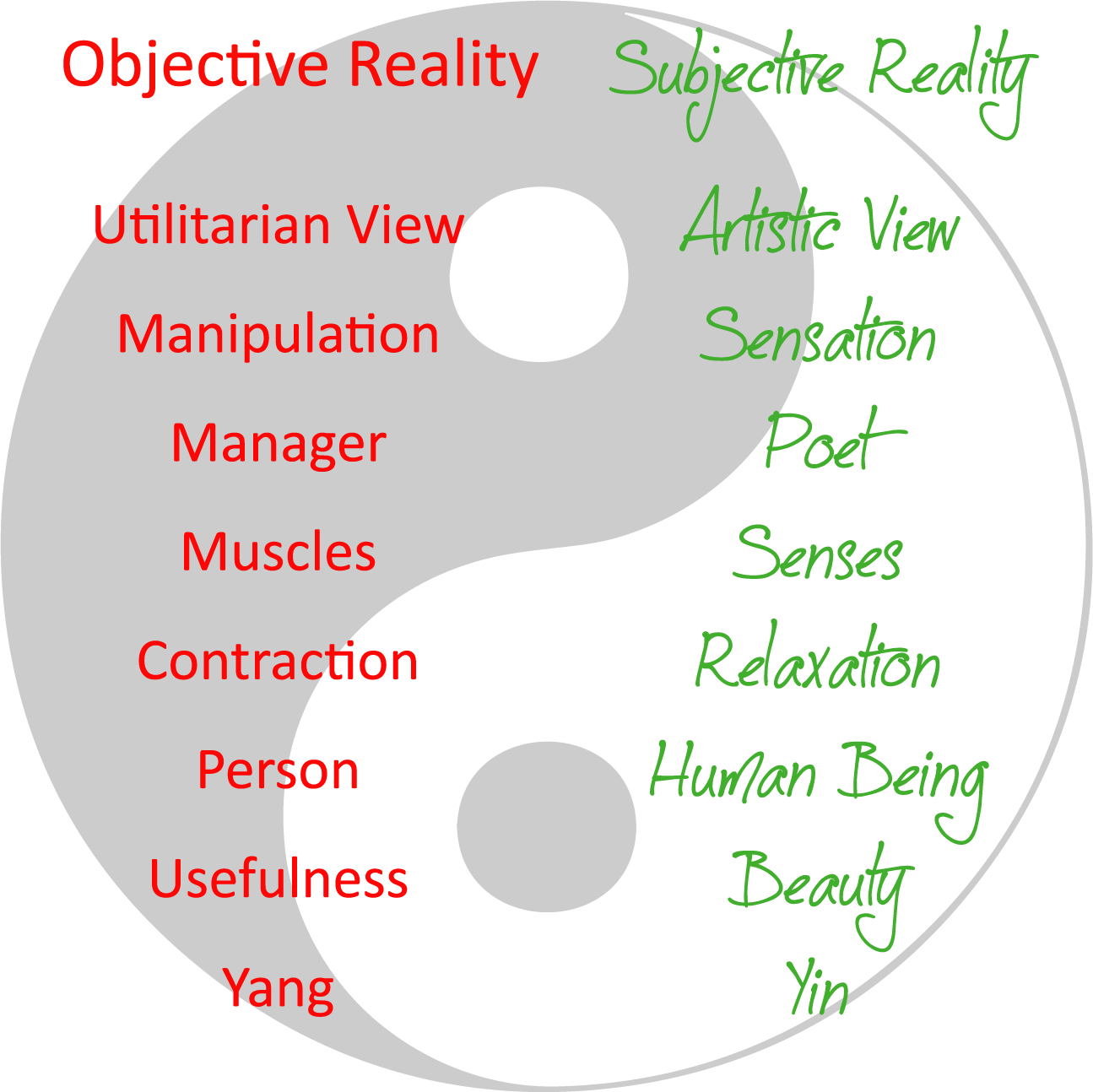
Image: author (inspiration from Erich Fromm’s The Art Of Listening)
In the past, religions and wisdom traditions provided the widespread teachings in this realm. Nowadays, however, at least in the West, religion has been marginalized to the point of almost being non-relevant anymore – at least when it comes to reaching and educating the masses.
Together with Huxley, also the Dalai Lama and Archbishop Tutu recognized that in the West, religion had been replaced by science. Observing the fact that secular education is nowadays almost universal, they too advocate to include in the formal education of our youth some teaching of compassion and basic ethics. Yet not on religious faith or belief, but on the basis of scientific findings, our common sense, and universal experience.
Since science finds more and more evidence that, among other things, basic human nature is compassionate, and that a one-sided view of life (i.e. the common Western utilitarian - yang - view) distorts our perception and causes all kinds of illnesses, both to people and the environment, I invite you to broaden your mind by reading and studying Huxley’s Island.

Image: Aristal
If nothing else, Island can be an inspiring starting point to change our perspective from merely creating George Carlin’s obedient workers, into creating a population capable of critical thinking – and simultaneously capable of loving with a heart that burns like fire.
Jolly greetings,
Erik
Notes & References
[1] From The Book Of Joy - His Holiness the Dalai Lama, Archbishop Desmond Tutu, Douglas Abrams.
[2] That was before I realized there's only one person who can push my buttons: me.
[3] From The Art Of Sexual Ecstasy – Margot Anand.
[4] While living in a forest and not far from a highway, when my emotional buttons were pushed and anger rose like a volcano, I also often ran towards a spot behind some trees right next to the highway. Subsequently, I would scream to the top of my lungs, knowing that the motorized traffic would absorb my noise easily. Like a volcano, I was thus able to blow out all my hot lava, and returned home when all the lava for that moment had been spewed.
[5] Or: Human Nature.
[6] In The Book Of Joy, compassion is one of the eight pillars of joy. The others being: (changing) perspective, humility, humor, acceptance, forgiveness, gratitude, and generosity. All these traits can be developed, cultivated, and consciously integrated into our daily lives, by means of which our feeling and experience of joy has the potential to, quite literally, explode.