Letting go is often perceived as something negative. This makes sense in a culture where possessing and grasping are marketed as the ultimate form of happiness. It is hardly surprising, then, that many of us suffer when something is - or must be - let go. I am no exception to this, a fact I was recently reminded of in no uncertain terms.
Yet, the very moments when we suffer the most are, nine times out of ten, eventually viewed as the most valuable moments of our lives (though only in hindsight, of course). For this reason, we are going to explore the process of letting go, whether voluntary or forced; how it gives rise to suffering; and what it might ultimately offer us.

Image: Thusithapix
Since my computer was still running Windows 10, it was time for an update to a new OS. Fortunately, I had an external hard drive lying around that I could use to back up my files.
The new OS ran just fine but it wouldn’t read my external hard drive. The diagnosis from a computer doctor: the drive is old and failing, though there’s a chance we might still be able to recover (some of) the files.
Naturally, that drive contains some ‘important’ files…
Just before I traveled to China in September 2023, I bought a brand-new external hard drive onto which I transferred all the documentation I had at the time. A little over a year later, it could no longer be read. The diagnosis back then: surgery is pointless because the patient has already died.
That drive contained, among other things, all the photos from the period immediately following my divorce: my very first home of my own (at the ‘De Maarnse Berg’ campsite) and the beautiful, wooded surroundings there; the colorful autumn of 2020, the pristine white snow of early 2021, and many other moments that served as reminders of the significant personal growth I experienced during that time.
Gone.
That cute little home I just mentioned? The site is now enclosed by a large fence, housing a rather ostentatious villa. The kind that would fit right into the finer neighborhoods of Beverly Hills.
The swimming pool from my youth, where I spent years competing in swim meets and playing water polo? It’s now a residential area.
The music venue where I had my first performances as a rock drummer? Residential area.
The school building where I spent my first year of secondary school? Residential area.
My primary school building? You guessed it…
You could say that the universe has gone to incredible lengths to make it clear that absolutely nothing is permanent, that everything is in a constant state of flux, and that, therefore, it is a waste of effort to desperately try to hold onto the past.
Yet, that is precisely what I was trying to do with all my might.
Throughout my early adulthood, I stayed in touch with teachers from my secondary school, my primary school—even my kindergarten. I stayed in touch with my friends from swimming and even with some of their parents. And until the age of 45, I made sure I never lived alone. Anything to avoid having to jump into that vast, scary, deep, and unknown abyss.
To eventually learn the art of letting go, I had to pass through some very dark valleys. Beyond intense emotional outbursts and various forms of distraction, this often manifested as fierce clashes with the people around me: from band mates and friends to close family members, and ultimately culminating in my divorce.
My tendency to clash with others, of course, stemmed from somewhere. Behind the big mouth that so often triggered these conflicts lay an incredibly insecure and fearful little boy. This bravado and tough exterior became an increasingly thick defensive wall, behind which I would hide whenever my buttons were pushed and I found myself unable to cope with the internal emotional whirlwind. In doing so, I was explicitly signaling "go away." While deep down, I was actually hoping for the exact opposite: see me, help me, embrace me!
In the lead-up to my divorce, my last major rupture, something shifted within the very core of my being. It suddenly became clear that my fear of the great unknown would only diminish if I looked it straight in the eye. In other words, if I finally dared to take a leap of faith and manage a household entirely on my own.

It is difficult to put into words just how incredibly valuable all the heartache, hardships, and conflicts have been for my personal development. In common parlance, we call this: suffering.
Yet, it is a well-known phenomenon that our most difficult moments, provided we make it through them, have a far greater impact on our formation and growth than times when everything goes smoothly. This applies to suffering in all its forms: mental, emotional, and physical.
I am certainly not suggesting that we should seek out suffering (though all mythological and spiritual heroes and sages have endured their fair share of hardships) - just as it would be unwise to exclusively pursue pleasure. Rather, it is about learning to engage with every situation exactly as it presents itself.
In itself, the statement ´my hard drive has died´ carries no emotional charge. That charge only arises when the realization of a significant loss sets in, triggering a deep-seated fear of loss, rooted in the widely held (cultural) belief that loss is inherently bad.
That is the moment when suffering begins. For as soon as we perceive a loss - whether it be the loss of possessions, loved ones, health, reputation, or anything else - we are confronted with various bodily sensations that we have labeled as unpleasant. And in such moments, we want only one thing: to be rid of those unpleasant sensations as quickly as possible.
Headaches, cramps, abdominal pain, nausea, restlessness, feeling hot or cold, a knot in your stomach, twisted-up intestines, various aches and pains, heart palpitations, hyperventilation—as soon as these or similar bodily sensations arise, we want to get rid of them because we have been taught that what is unpleasant is also undesirable. What we are not taught, however, is that the universe we live in operates entirely on this principle:
arising – existing – passing away
This applies literally to everything. People, animals, planets, rocks, stars, cars, flowers, tissues, skyscrapers, seashells, concerts, fights; every phenomenon that arises exists for a time, only to eventually and inevitably pass away. And in the vast majority of cases, this happens without any input from us at all.
In other words, all the effort we expend trying to avoid feeling unpleasant bodily sensations - an endeavor upon which a large part of our economic model is built - is actually effort in vain, unless we are willing to learn from our mistakes.
For me, a headache is always a sign that I am becoming far too worked up about something (much like fatigue, catching a cold, or throwing out my back). Over time, these ´ailments´ have taught me that, in some aspect of my life, I am either holding on too tightly or rigidly pushing something away. Once it becomes clear which aspect that is, and I make the necessary changes, the headache vanishes as if by magic.
However, if I take paracetamol to compulsively push away a headache, without looking at its cause, I miss out on an important lesson and continue to overextend myself in one or more areas of my life. It stands to reason that the headache will return more frequently and with greater intensity, as will other ailments, if I simply keep charging ahead.[1]
By viewing the body as a teacher and a gauge, rather than as a mechanical vehicle meant solely to carry out our will, it becomes our most valuable partner amidst the turbulent waters of life.
Whenever we become stressed, our body signals this through various physical sensations. The better we learn to read the signs of our body, the more aware we become of the moments when stress arises, and the more effectively we can practice the art of NOT reacting.
When we respond to unpleasant physical sensations with aversion (that is, by trying to push them away) or to pleasant sensations with craving (essentially trying to possess them and keep them with us forever), we only reinforce our deeply ingrained habit patterns. If, however, we learn to fully enjoy pleasant moments without needing to possess them, and to accept unpleasant moments without trying to banish them, we will find that other habit patterns—those that no longer serve us—begin to lose their grip on us.
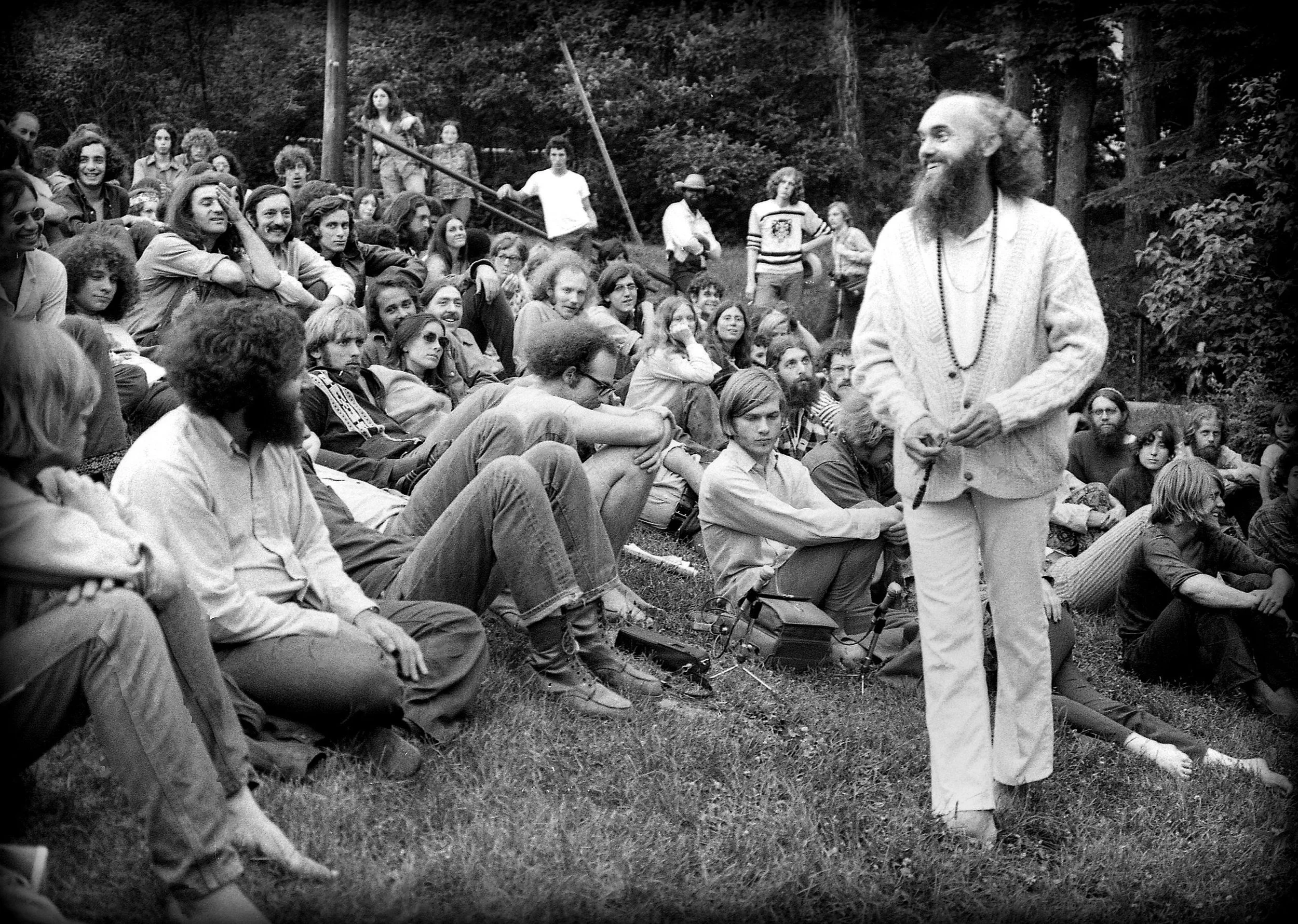
In this sense, we can view every moment of our lives as a teaching. It is much like a conversation between Ram Dass and his invisible friend, Emmanuel, in which Ram Dass asked what his purpose in life was. Emmanuel replied: "Ram Dass, you are in school. Why not take the curriculum?" This refers to the idea that you can view every moment as a lesson; an opportunity to get to know yourself better. And the better you know yourself, the better you understand others. Likewise, the more tolerant you become toward yourself, the more tolerant you become toward others.
So, instead of viewing the phenomenon of suffering as something undesirable, it would be wise to shift our perspective and begin to see it as a source of our most valuable lessons.
Naturally, we wish to alleviate pain and suffering, both our own and that of others, which is, in itself, always a noble goal. However, help only becomes effective when the person in need is open to receiving it - and when the assistance offered is truly selfless in nature.[2]
Accepted help only becomes truly valuable once an individual has made peace with their suffering. Until that point, any form of help may feel imposed, as the sufferer is still actively resisting his/her suffering. In this sense, suffering can become an incredibly valuable teacher once the person suffering realizes that true peace and harmony are found by ceasing the obsessive attempt to push the suffering away. It is the realization that pain and suffering are two very different things.
Furthermore, the help one offers, for instance if I wish to help alleviate someone else’s suffering, becomes increasingly valuable the less I rely on it to satisfy my own (often unconscious) personal motives (in other words, the more selfless it becomes). As mentioned above: if someone is not open to my help, yet I feel a need for recognition in my role as a ´helper,´ I might be inclined to force my ´helpfulness´ own their throat. And who am I to take away someone’s suffering against their will, when that very suffering might be the path toward their own liberation?
Jolly greetings,
Erik
Note & Reference
[1] By which I certainly do not mean that we should never take a paracetamol against pain.
[2] In the book ‘How Can I Help?’ by Ram Dass and Paul Gorman, these propositions are explored and discussed in detail.