The Mirror of Jekyll and Hyde
Reading time: 6 minutes
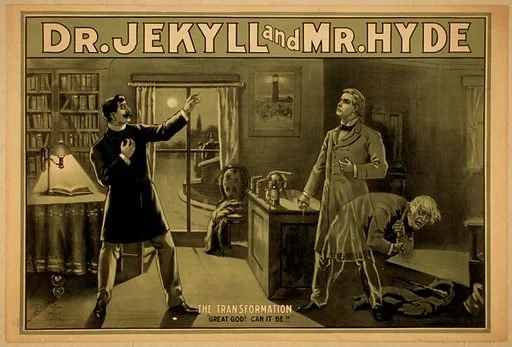
Hyde turning into Jekyll in front of Dr. Hastie Lanyon.
Introduction: The fame of Jekyll and Hyde
A quick glance shows that in popular culture, the figures of Jekyll and Hyde appear in countless plays, movies, and books. One of the main reasons why they are household names across many nations, is because they so adequately evoke that notorious pull between good and evil that lives inside us all.
The fact that the term ‘Jekyll and Hyde personality’ is widely used to describe characters who live a life of outward sanctity and inward venom, bears witness to the inventiveness of Robert Louis Stevenson’s story. However, as most people know of The Strange Case of Dr Jekyll and Mr Hyde instead of actually knowing it, I took it upon myself to actually read the 100 pages that comprise the tale.
The dual nature of humanity
Every religion tells us to do good and it appears in our nature to do so. Yet we all know how it feels when primal urges rear their heads. Whatever their form – pride, lust, greed, wrath, gluttony, sloth, envy – their appealing forces can be formidable, and are for many of us irresistible.
We also know that if we give in to our urges without limits, others will suffer the consequences of our vices – of which Hyde's victims are the (sometimes silent) witnesses. What is less known, however, is that by the same actions dire consequences will be ours as well – as Jekyll’s demise makes painfully clear.
The effects of repressing our nature
The profundity of this tale lies in Stevenson’s masterful narrative of what happens when we repress urges that are particular to our individual nature – innocent as they may be.
Dr. Henry Jekyll is born into a distinguished family with a large fortune, and is by nature a rather jolly fellow. However, as G.K. Chesterton rightly observed, humour and gaiety belong to the people and not the upper class. Therefore, by his own standards he felt so much shame for what he called ‘his pleasures’, that while others might have thought nothing of them, Jekyll concealed them with all his might.
“Indeed the worst of my faults was a certain impatient gaiety of disposition, such has made the happiness of many, but such as I found it hard to reconcile with my imperious desire to carry my head high, and wear a more than commonly grave countenance before the public.”
Immediately we recognize a tendency to hush up and conceal certain traits that are particular to our individual nature, like gaiety, vanity, curiosity, or anything we feel to be inappropriate. We feel shame for them for any number of reasons and wish to be rid of them with all our might, lest others find out about them. But the harder we try to repress them, the more violent they appear to take us over at every given opportunity – especially when we let our guards down.
When evil takes over
Being good-natured and jolly at heart, but feeling an almost morbid sense of shame for these ‘irregularities’, Jekyll repressed his nature with said grave countenance. Yet we can only deny our own nature for so long, for at some point it will rise to the surface. And the harder our repression, the more cruel its emergence – which is portrayed in this story by the figure of Edward Hyde.
Hyde is an unscrupulous being with the body of a well sized dwarf who is interested in nothing but himself. In those respects he resembles an infant, with an underdeveloped body and who is unscrupulous in voicing his needs at every hour of the day and night. And in a sense, Hyde is an infant – if we take into consideration that by Jekyll’s repression, his true nature (jolly and gay) never had a chance to grow up, develop, and mature.
But Hyde is also an incarnation of what we call pure evil: willing to inflict pain and filled with hatred and fear. In that respect he resembles the archetype of a bully with a desire to do harm out of hatred, but not willing to face the consequences out of fear for himself. For whereas Hyde represents a repressed and neglected side of Jekyll on the one hand, he copies the other’s sense of shame on the other hand. After all, they are one and the same person.
Stevenson masterfully shows us that underneath every evil person you’ll find a scared little child – no matter how tough they act. But if that child is refused to live out its individual nature, or even to exist at all, chances are big that it will emerge at some point as our own personal version of Edward Hyde: deformed, underdeveloped, and mighty angry for having been denied proper nourishment and the right to exist.
We usually refer to that side of ourselves as our dark side (or, as Jung did: our shadow).
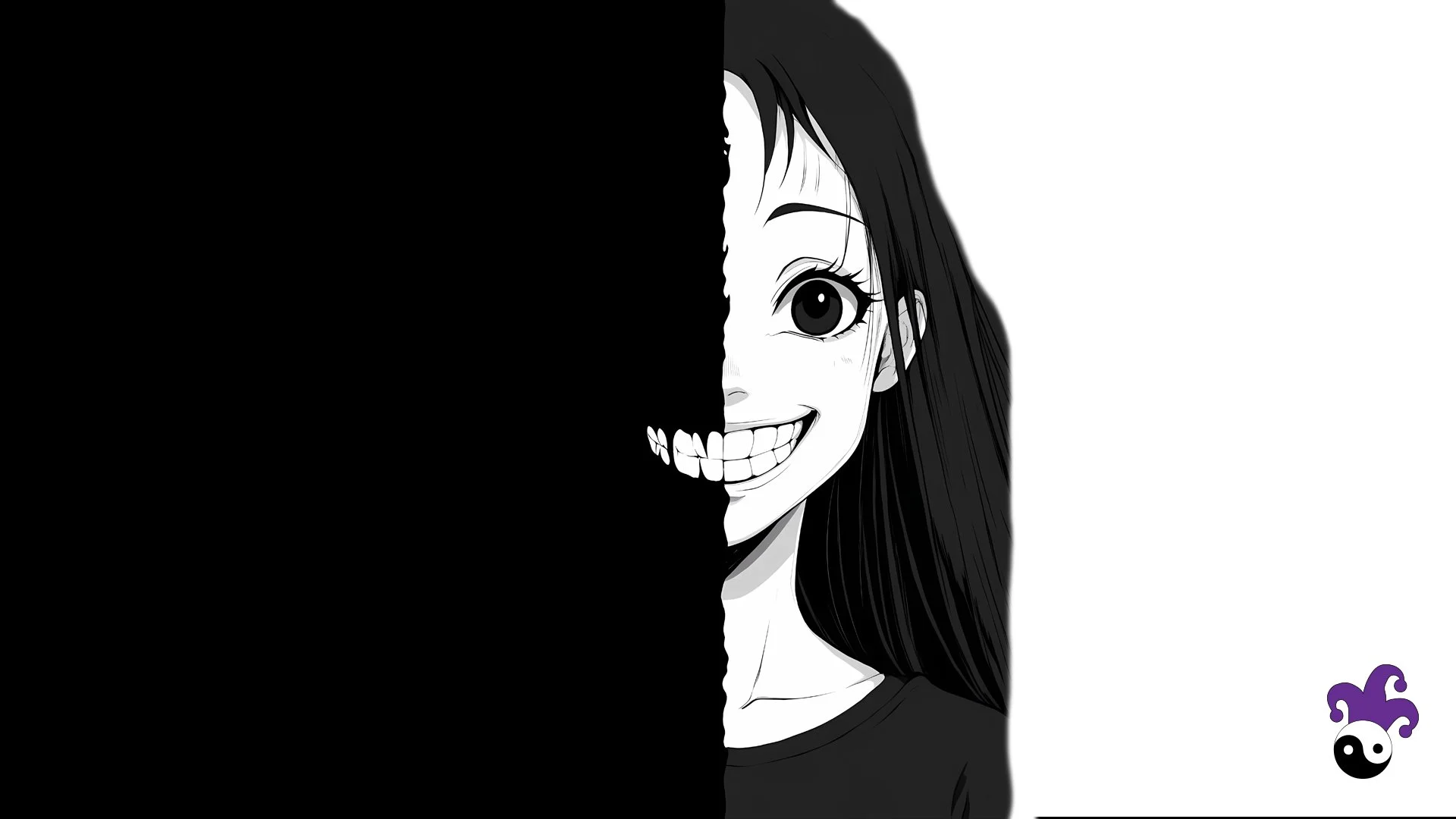
Our dark and light sides. Illustration: Vilkasss. Edit: author.
How balance works
Nature always seeks balance and the human fate is defined by the pendulum-like move between the forces of good and evil. Yet good and evil as such are not natural phenomena. They are culturally determined and if Jekyll would have been born into the so called ‘lower classes’, he might not have had any problem in living out a jolly and gay nature in full. However, if in that instance his nature would have been very serious and precise, than those traits could have easily caused shame and repression within him for fear of being seen as a ‘nerd’.
The Strange Case of Dr. Jekyll and Mr. Hyde was first published in Victorian England (1886), where keeping up appearances and stiff upper lip were commonplace. In other words, you had to behave according to a certain set of norms and standards or you were ostracized, which was a fate worse than death in England in those days. However, since individual human beings can impossibly be forced into any kind of unified moral or behavioural straight jacket, it is no surprise that the repression of our dark side breaks out in numerous – and often horrific – ways.
Acceptance vs Resistance
As we can see here, the circumstances in which we are born determine for a large part what we regard as good and evil – and often they do not coincide with our individual nature. We experience this both within ourselves and also on a grand scale in movements and societies: peace follows war and back again in endless cycles. Yet, an uncomfortable truth is that the harder we try to cling to one (peace) and avoid the other (war), the more likely peace is lost and war breaks out – both within the microcosm of our own body and mind, and in the external world.
So here we have a tale that warns us of the dangers of forcefully trying to repress our own individual nature. In the East, in Buddhism, Hinduism, and Taoism, this is already known for thousands of years, which is why these religions and traditions provide practical means with which every individual can develop – and live in peace with – their own nature (our nature effectively consists of our innate skills and talents).
The truth of suffering
Thus the deeper message of The Strange Case is that our dark side is not our enemy. It comprises of our inner children whose pain have not yet been processed and it’s up to us, adult people living in the here-and-now, to start paying attention to them.
For almost nobody gets through the process of culturalization unscathed. Almost everyone experiences clashes between the culture they grow up in and their individual nature. In the process we get hurt and the longer that pain remains unacknowledged, the more evil gets a foothold within us.
Yet by acknowledging that we have been hurt, we open the door to accept, embrace, and make peace with our inner children. Acceptance of the reality of suffering, therefore, is a vital step in our quest for peace and harmony, and it’s not for nothing that it’s the first of the Buddha’s Four Noble Truths.
Conclusion: Holding up a mirror
Like many classics, The Strange Case of Dr. Jekyll and Mr. Hyde describes an apt diagnosis of the human condition, and contains an intrinsic warning. For as long as we do not accept our own nature as individuals, with all the traits we’ve been endowed with in this current incarnation, it will at some point claim its rightful place in our lives. Whether by fair means or foul – that is ultimately up to us.
Jolly reading,
Erik
Are you open?
Dear reader, since every human being has a unique outlook on life by default, we’d love to learn about your views of the world. You are therefore invited to either leave a comment underneath this article, or contact us if you’d like to share a philosophic and stimulating article via this website.